
The Trypsin Activity Colorimetric Assay Kit is an advanced tool used to measure the activity of trypsin, a key digestive enzyme that plays an essential role in protein breakdown. This kit is commonly used in research fields such as biochemistry, pharmacology, and molecular biology to analyze trypsin’s function in various physiological and pathological processes.
Key Features of the Trypsin Activity Colorimetric Assay Kit
- High Sensitivity: This assay offers high sensitivity in detecting trypsin activity, allowing for precise quantification in complex biological samples such as plasma, serum, or tissue extracts. Studies using this kit have been published on databases like PubMed.
- Quantitative Measurement: By employing a colorimetric detection method, the kit enables accurate quantification of trypsin activity. The change in color intensity is proportional to the enzyme’s activity level, making it an excellent tool for high-throughput screening in drug development, as seen in research funded by the NIH.
- Wide Applications: This kit is applicable across various biological studies involving digestive enzymes, such as those focusing on pancreatic function and digestive disorders. It has been used in studies supported by the National Institute of Diabetes and Digestive and Kidney Diseases (NIDDK).

Mechanism of Action
Trypsin is a serine protease produced in the pancreas as an inactive zymogen, trypsinogen. Upon activation, trypsin breaks down proteins into smaller peptides, a critical process in the digestive system. By using a colorimetric substrate that reacts with trypsin, the assay kit generates a measurable color change that corresponds to the enzyme’s activity, which is then quantified using a spectrophotometer.
The specificity of the kit ensures accurate measurement, making it a valuable tool for researchers studying protease inhibitors or investigating trypsin’s role in diseases such as acute pancreatitis, as described in research on NIH-funded platforms.
Applications in Research
- Pancreatic Disorders: The kit is widely used in the study of acute and chronic pancreatitis, where trypsin levels are elevated. Research projects funded by the NIDDK have utilized this kit to explore how trypsin activity contributes to pancreatic inflammation.
- Protease Inhibitor Studies: Trypsin inhibitors are of significant interest in therapeutic development, particularly for conditions like cystic fibrosis and hereditary pancreatitis. The Trypsin Activity Assay Kit is often employed to screen for protease inhibitors in drug discovery efforts, which is a focus of the FDA.
- Digestive Enzyme Research: Understanding how trypsin and other digestive enzymes function is crucial in gastrointestinal research. The kit has been used in various studies, such as those conducted by academic institutions supported by the National Science Foundation (NSF), to investigate how enzyme activity is regulated in the digestive system.
Procedure and Workflow
The Trypsin Activity Colorimetric Assay Kit operates on a straightforward workflow:
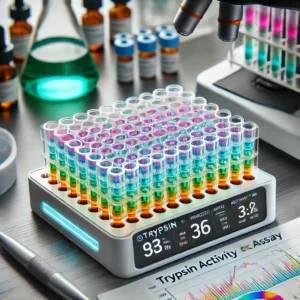
- Sample Preparation: Biological samples such as serum, plasma, or tissue extracts are prepared and placed in a 96-well microplate, which is a common format used in NIH and NSF-supported studies.
- Reaction Initiation: A colorimetric substrate, specific to trypsin, is added to each well. Upon cleavage by trypsin, the substrate releases a chromophore, resulting in a visible color change.
- Measurement: The reaction is measured using a spectrophotometer at a specific wavelength, typically 405 nm. The intensity of the color is directly proportional to the amount of active trypsin in the sample, a principle utilized in studies archived on PubMed Central.
- Data Analysis: Results are analyzed to determine trypsin activity, which can be compared across different experimental conditions or between control and disease samples.
Advantages of the Trypsin Activity Colorimetric Assay Kit
- High Throughput: The kit’s 96-well plate format allows for the simultaneous analysis of multiple samples, ideal for large-scale research or drug screening programs in laboratories supported by NIH funding.
- Versatility: Suitable for measuring trypsin activity in a variety of sample types, including serum, plasma, and cell lysates. This makes it useful for studies investigating multiple biological systems, as demonstrated by research on PubMed.
- Cost-Effective: Compared to more advanced techniques like mass spectrometry, this kit provides a simpler, cost-effective solution for measuring enzyme activity, making it a popular choice in academic research supported by the NSF.
Applications in Education and Government Research
The Trypsin Activity Colorimetric Assay Kit is not only a tool for research but also a valuable educational resource. Students in biochemistry and molecular biology courses use it to learn fundamental techniques in enzyme kinetics. Government research institutions such as the Centers for Disease Control and Prevention (CDC) and FDA utilize the kit in public health and regulatory studies, where accurate measurement of enzyme activity is critical for understanding disease mechanisms.
Conclusion
The Trypsin Activity Colorimetric Assay Kit is indispensable in enzyme research, offering precise and high-throughput measurement of trypsin activity in a variety of sample types. Its application spans studies on pancreatic function, protease inhibitors, and digestive disorders, making it a versatile tool in both basic research and clinical settings. Whether in academic labs or government-funded research projects, this kit plays a critical role in advancing the understanding of digestive enzymes and their impact on health.